From Finland to Lindau Nobel Laureate Meetings: Meaningful Moments with Superheroes
Teksti IbrahiM Abdelsalam, kuvat IbrahiM Abdelsalam, Lindau Nobel Laureate Meeting
I got selected for the participation in the 74th Lindau Nobel laureate meeting nominated by the council of Finnish academics. I had the opportunity to spend seven days along with 32 Nobel laureate and over 600 young researchers from the whole world.
John Jumper was one the Nobel laureates who inspirated young scientists like IbrahiM Abdelsalam in Lindau, Bavaria.
Lindau Nobel Laureate event provided unique access to the laureates’ personal stories, advice on scientific careers, and insights into breakthrough research across disciplines.
Workshops, panel discussions, and informal gatherings encouraged open dialogue and fostered an atmosphere of collaboration and mentorship. The yield of this trip lies in the exchange of scientific ideas, formation of international research networks, and renewed inspiration for scientific discovery and excellence.
To provide a more vivid and personal perspective on this journey, I openly shared my whole experiences and insights in series posts on LinkedIn (AbrahaM Abdelsalam | LinkedIn).
The experience left me with memories and insights that will stay with me for the rest of my career. I will summarize them in the following sections.
”A human with a phone is a cyborg.”
Before the official opening of the Lindau Nobel Laureate Meetings, I had the privilege of attending the Merck Group Celebration Award ceremony, where this year’s honour was bestowed upon Professor Alán Aspuru-Guzik from the University of Toronto.
In a captivating talk on digital chemistry, he illustrated how AI is accelerating the optimization and discovery of new materials, including safer alternatives to harmful substances.
One striking line that stayed with me: “A human with a phone is a cyborg.” His words perfectly captured the fusion of human ingenuity and machine intelligence driving modern science.
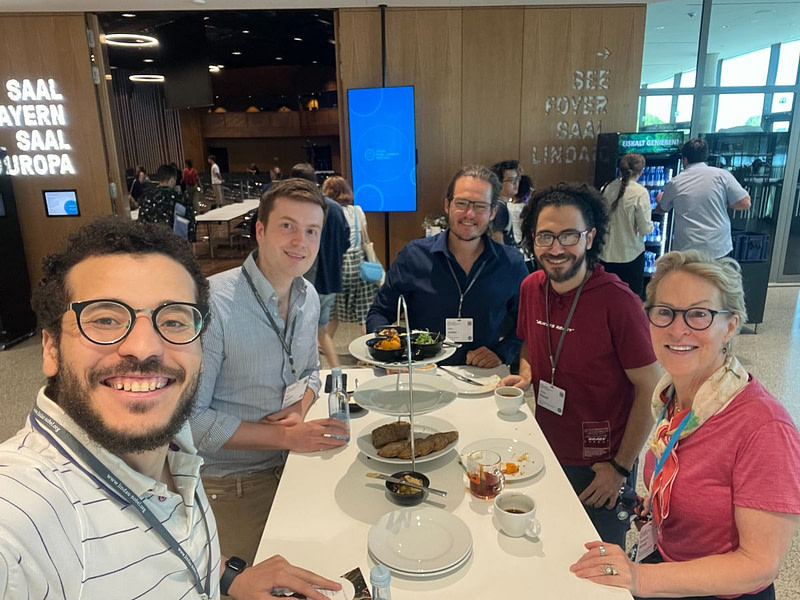
Nobel laureate Frances Arnold shared a breakfast with younger scientists.
The first day at Lindau Nobel Laureate Meetings began, I can hardly describe the excitement of seeing my name printed alongside such scientific legends. Before the official start, as a young researcher, I was granted the extraordinary opportunity to meet the very people who first ignited my scientific curiosity — my role models and inspirations.
Standing among them, I felt a deep sense of gratitude and motivation. One of the highlights was a speech by Frances Arnold (Caltech, 2018 Nobel Prize for the directed evolution of enzymes). I found her words especially inspiring:
”We have a lot to learn from nature — how it builds and breaks down molecules; think about assembling life from renewable resources, recycling everything, generating little waste.”
”Be proud of being a chemist.”
Next was a panel with Alex Adam hosting Nobelists Bernard L. Feringa (University of Groningen, 2016 Nobel Prize for the design and synthesis of molecular machines) and David MacMillan (Princeton University, 2021 Nobel Prize for the development of asymmetric organocatalysis), discussing key topics in chemistry.
Ben Feringa shared, “My dream is that when we celebrate the 100th anniversary of the Lindau Meeting, some young star from this room will say, ‘We’ve created a primitive life form in the lab, with traits of living organisms.’”
He urged us, “Be proud of being a chemist – that’s my message. We need to work harder on public outreach, explaining why chemistry matters.”
David MacMillan emphasized, “Understanding the fundamentals of new catalytic methods will prove invaluable,” and his top advice: “Listen to yourself and follow what you really want to do.”
The day’s panel discussion dove into the impact of winning a Nobel Prize, with Martin Chalfie (Columbia University, 2008 Nobel Prize for the discovery and development of green fluorescent protein), Frances Arnold (2018), and John Jumper (Google DeepMind, 2024 Nobel Prize for AlphaFold).
They all agreed: the true reward isn’t only in prizes, but in publishing work that benefits all of humanity. As one panelist said, “A published paper in Nature – or any respected journal – can be as significant as a Nobel Prize.”
IbrahiM Abdelsalam is a doctoral candidate at the Department of Chemistry, University of Helsinki.
The week continued with a series of inspiring scientific talks. Moungi Bawendi (MIT, 2023 Nobel Prize for the discovery and synthesis of quantum dots) reminded us of the importance of perseverance with his key message: “The importance of long-term curiosity driven research”.
I was fortunate to have a meaningful conversation with him afterward, where we discussed challenges around scalability and stability in his field an eye opening and enriching exchange.
Gregory Winter (MRC Laboratory of Molecular Biology, 2018 Nobel Prize shared with Arnold and George Smith) spoke passionately about the life-saving potential of patents – how intellectual property can literally save lives.
His talk reminded me of Helsinki Innovation Services Ltd, Helsinki Incubators and our ongoing ReLight (University of Helsinki R2B) project at University of Helsinki of Helsinki. It’s a great example of how local innovation, backed by supportive people, can strive to make a global impact.
David MacMillan and I share the same favorite football team: Manchester United.
A Breakfast to Remember
The morning began on a high note with the privilege of attending a Partner Breakfast hosted by Texas A&M University. After a quick breakfast, the event transitioned into the very first panel discussion of Lindau Nobel Laureate Meetings, an exciting milestone as it was also the first to allow audience questions. The panel, led by Alex Adams and joined by Nobel Laureate David MacMillan, explored how catalysis shapes society and our everyday lives.
I was thrilled to ask the second question of the entire Lindau Meeting, a moment I won’t soon forget. Even more surprising and delightful was learning that David MacMillan and I share the same favorite football team: Manchester United.
One morning over breakfast, I had the privilege of sitting down with Nobel Laureate Frances Arnold. She generously shared her secrets to captivating public speaking, and we talked about how, as chemists, we can better connect with society by showing the vital role chemistry plays in our everyday lives.
That conversation, as casual as it seemed at the time, left me with a powerful reminder that communication is itself a form of leadership.
”Communication is itself a form of leadership.”
Scelerisque uam sem fringilla malesuada ut morbi tincidunt.
A walk inspiring scientist
I had the incredible privilege of joining a Science Walk on the picturesque Lindau Island, alongside ten brilliant young researchers from around the world.
What made this experience truly unforgettable was walking side by side with Nobel laureate Morten Meldal (University of Copenhagen, 2022 Nobel Prize for the development of click chemistry and bioorthogonal chemistry), a Nobel Laureate whose humility and brilliance left a profound impact on me.
During our walk, I had the chance to speak to Morten about his scientific path and the principles that guided him to success.
”Science isn’t just a career, it’s a way of living.”
What struck me the most was not just his intellect, but his humility and genuine interest in each of us. He answered all our questions with warmth, insight, and a spark of encouragement, making us feel seen, heard, and inspired, which is the main message of the Lindau meeting.
I was deeply moved by our conversation, where he shared personal stories, including his reaction to winning the Nobel Prize, his creative side as a songwriter and singer, and his thoughts on the importance of pursuing science with passion and joy.
His message was clear: science isn’t just a career, it’s a way of living, learning, and giving back.
This experience was a once in a lifetime moment for me. Walking and learning from someone like Morten Meldal didn’t just teach me about science, it reminded me of the humanity at the heart of discovery. I will carry the inspiration he gave us for the rest of my journey, both as a scientist and a person.
Every moment was a special till end
Even during our boat trip to Mainau Island, I found myself in conversation with Nobel Laureate Moungi Bawendi.
We spoke about the role of mentorship in shaping an academic career and about how he chose the lab for his very first postdoc, a decision that set the course for his groundbreaking work.
Walking alongside him was an especially meaningful moment for me, since Professor Bawendi is considered the founder of the very field in which I am conducting my own research. To hear his reflections firsthand felt both surreal and deeply inspiring.
Professor Moungi Bawendi is considered the founder of the very field in which I am conducting my own research.
About the author IbrahiM Abdelsalam
My name is IbrahiM Abdelsalam (the capital M at the end of my first name is a tribute to my mother, to whom I owe so much). I am a doctoral candidate at the Department of Chemistry, Faculty of Science, University of Helsinki.
I conduct my doctoral research in the Plasmonic and Nanocatalysis Group, led by Professor Pedro Camargo to whom I owe my appreciation and regards for his help and support.
My research focuses on engineering nanomaterials that can harness solar energy and convert it into chemical energy-paving the way for more efficient green hydrogen production.
With Finland’s strong commitment to sustainability and energy innovation, I feel motivated to contribute to meaningful, long-lasting solutions.