Nobel-tähtien opissa eli Chemistry Beyond the Lab: Nobel Laureates as Public Figures
Teksti Mai Soliman, kuvat Torben Nuding, Patrick Kunkel, Lindau Nobel Laureate Meeting
This year’s Lindau meeting showed me that these Nobel Laureates are not just chemists, they are public figures, advocates, and diplomats.
Over 600 young scientists were listening to the wise men and women in Bavaria.
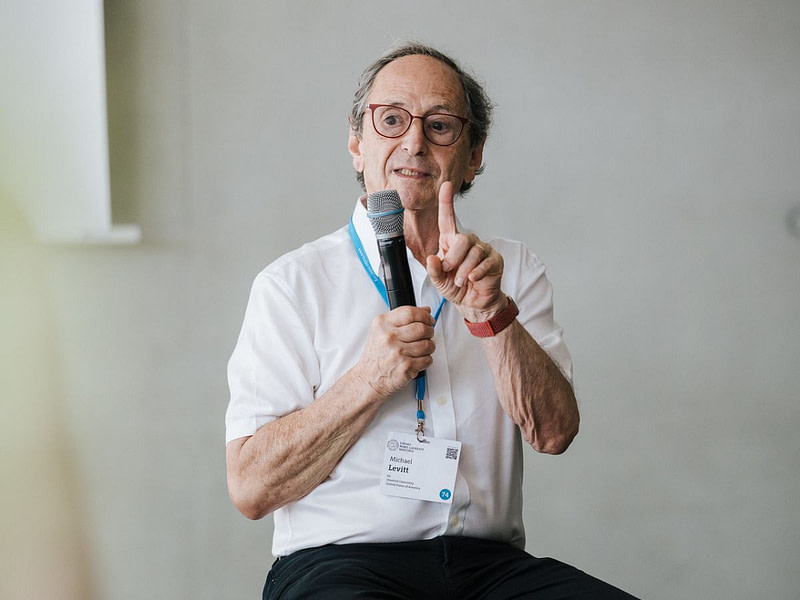
Nobel Prize winner 2013 Michael Levitt was one the science stars inspirating young young chemistry researchers in Lindau meeting.
In the words of Micheal Levitt (2013 Nobel Prize): ”You feel responsibility as laureate. When you get the Nobel prize, it is sort of like you become Superman. Nobody is going to cancel you, nobody is going to take away your tenure, or they would try very hard.”
Nobel Prize winner 2013 Michael Levitt was one the science stars inspirating young young chemistry researchers in Lindau meeting. Photo Torben Nuding/Lindau Nobel Laureate Meetings.
Chemistry as Responsibility
Winning a Nobel Prize brings prestige, funding, and collaboration, but also intense pressure. Laureates are often called to advise presidents, deliver public speeches, and represent science globally.
In a panel discussion between Frances Arnold (Caltech, 2018 Nobel Prize for the directed evolution of enzymes), Martin Chalfie (Columbia University, 2008 Nobel Prize for the discovery and development of green fluorescent protein), and John Jumper (Google DeepMind, 2024 Nobel Prize for AlphaFold), they were asked to reflect on these expectations.
Frances described serving on the U.S. President Joe Biden’s Council of Advisors on Science and Technology, where she was asked all sorts of questions. Questions, that even as a Nobel prize winner, she did not have answers for.
She spoke candidly about the difficulties of balancing research, tenure, and raising three children as a woman in science, recalling that her Nobel-winning work came during ”a low point” when “everything was uncertain.”
When asked about family and career balance, she said: ”I was not perfect, but I did my best. And that was what mattered.”
”John Jumper worried about jumping into responsibility.”
John Jumper, still new to public life, admitted he was unsure of his role as an advocate and worried about jumping into unpredictable responsibility.
This portrayed to me the pressure that laureates are put under, where they are tasked to transition from scientists in labs to public speakers. Martin, however, embraced advocacy, chairing the U.S. National Academies’ Committee on Human Rights since 2015.
Frances Arnold, Martin Chalfie, and John Jumper discussing their opinions on the responsibility of winning the Nobel prize as they were asked by the moderator. Green means agree. Red means disagree. Photo Lindau Nobel Laureate Meetings.
Chemistry in Politics
Lindau did not shy away from political realities. As a matter of fact, I was surprised to see that Lindau meetings seemed to embrace them.
In her opening words to the Lindau meeting, Countess Bettina Bernadotte of Wisborg welcomed attendees and thanked sponsors, but then grew serious:
Ten selected young scientists from the US could not make it to Lindau, as they were advised that leaving the country would endanger their opportunity to return. She called this against the principles of Lindau and academia, to connect, inspire, and educate.
In U.S. scientists are no longer welcome as advisors at the highest level. Not even Nobel laureates.
These words were followed by those of Frances Arnold, stepping on the podium. She described the current U.S. research funding as “utter chaos,” lamenting that scientists are no longer welcome as advisors at the highest level, that she and her colleagues are no longer appreciated.
These words were met by a huge applause from the audience, reflecting not only the understanding of other laureates, but the awareness of the young scientists themselves.
In another public exchange with Reinhard Genzel (Max Planck Institute for Extraterrestrial Physics; 2020 Nobel Prize for the discovery of a supermassive black hole at the centre of our galaxy) during the same day, he also raised alarms.
When asked about Starlink regulation, he joked about U.S. policy with his sharp wit. The entire room’s atmosphere was calm. However, this changed dramatically when he ended the discussion gravely:
”A country like the US, which really built its strength to a significant extent on the impact of people from the outside, and now they are saying we do not want to have research anymore. I cannot explain it; I do not understand it.”
”Like the Germans, my father immigrated [from Germany] in 1959 to the US. On Sunday school, he was asked one question: ‘Why didn’t you protest? Why didn’t you do something?’ You can imagine, I am asking my friends who have been fired, and the Democrats the same question: ‘Where are you?’”
I watched as the room fell silent, a stark reminder that chemistry and politics are deeply intertwined.
Reinhard Genzel speaking about galaxies, space, Starlink, and his opinion on the current situation in the US. Photo Torben Nuding/Lindau Nobel Laureate Meetings.
Chemistry in Healthcare Advocacy
Several laureates used their platforms to advocate for accessible medicine. Sir Gregory Winter gave a lecture about his groundbreaking work that realized humanized antibodies. At the time, he was working with a pharmaceutical company, CellTech to produce these antibodies.
Winter described how a single patient changed his career trajectory. He recounted meeting a woman with non-Hodgkin lymphoma, whose tumor regressed after treatment with the humanized antibody he helped develop.
When asked how long she had to live, Gregory said he didn’t know; she replied: ”Two months is enough. My husband is dying. I want to be with him when he dies.”
The pain and simplicity in this patient’s words, he said, ”shook” him. Gregory went on to challenge CellTech’s attempts to monopolize antibody therapies, threatening to destroy his own invention if access was restricted. ”I invoked a crisis,” he recalled. His fight ultimately ensured humanized antibodies became widely available, saving countless lives.
I attended a separate session on medical challenges in 2025 between Michael Levitt (Stanford University, 2013 Nobel Prize for the development of multiscale models for complex chemical systems) and Aaron Ciechanover (Technion, 2004 Nobel Prize for the discovery of ubiquitin-mediated protein degradation). Both raised concerns about ethics in medicine.
”It is unacceptable that we have a drug at hand, we have a patient that is sick, and the patient cannot get the treatment.”
Aaron spoke bluntly about pharmaceutical industries’ drug pricing:
”For example, molecular treatment for spinal cord atrophy costs a million dollars per patient. No country, even the richest, can afford it. No insurance company can afford it.”
”This makes the drug itself inaccessible. Which we know in medicine is unacceptable. It is unacceptable that we have a drug at hand, we have a patient that is sick, and the patient cannot get the treatment. This is unacceptable for us as physicians and as human beings.”
Micheal predicted that AI-driven drug discovery in India and China will make cheaper therapies inevitable, reshaping global pharma.
Aaron Ciechanover speaking about ethics in medicine. Photo Patrick Kunkel/Lindau Nobel Laureate Meetings.
Chemistry and Scientific Diplomacy
For the first time, I heard the term scientific diplomacy at Lindau: scientific exchanges that can advance international relations.
Three workshops explored diversity, equity, and wellness, culminating in concrete action plans. Attending these workshops, we were assigned groups as young scientists, in my group, we began designing a survey on equity, power dynamics, and mental health in academia, which we aim to publish in a peer-reviewed journal next year.
Maybe this is a good moment to highlight the young scientists in the meeting. I was surprised by how globally aware young scientists were, how outspoken they were about inequality, mental health, and the climate, and how passionate they were about change. When I looked around me, I had hope that the future can be changed for the better.
Two laureates led by example. Peter Agre (John Hopkins University, 2003 Nobel Prize for the discovery of Aquaporins) recounted fostering collaboration with Cuba, North Korea, and Iran to fight disease, while Martin Chalfie spoke of his work integrating human rights into STEM education.
Martin, Peter, and Frances listening to the culmination of young scientists workshops on scientific diplomacy. Proto Patrick Kunkel/Lindau Nobel Laureate Meetings.
At a panel, Martin emphasized that science is a ”global enterprise”, and diversity is not just representation but a source of innovation. Peter stressed patience: the 2015 Iran Nuclear Deal, he said, was possible because of relationships built between two scientists who first met at MIT.
Martin closed with a striking reflection: had he not joined global scientific circles, he would never have known about issues like famine-related stunted growth. He admitted his shame of being unaware of global issues as a scientist.
Author Mai Soliman is a doctoral candidate at the Division of Pharmaceutical Chemistry and Technology, Faculty of Pharmacy, University of Helsinki.
”Lindau showed me the weight of chemistry”
For many young scientists, Lindau is remembered as inspirational, a once-in-a-lifetime chance to meet Nobel laureates. Yet this year also showed me the weight of chemistry: its power to change medicine, its entanglement with politics, and its potential as a tool of diplomacy.
The laureates’ stories reminded me that chemistry is not isolated in laboratories. It is a human enterprise, and with its triumphs comes moral responsibility.
About the author Mai Soliman
I am a doctoral candidate at the Division of Pharmaceutical Chemistry and Technology, Faculty of Pharmacy, University of Helsinki. I owe my appreciation to my supervisors: assistant professor Shiqi Wang and professor Timo Laaksonen who support and aid me in my scientific journey.
My research focuses on the use of bioorthogonal chemistry and metabolic labelling for the development of an assay that can detect and quantify nanoparticle-glycoprotein endocytosis. I am also an active member in the Young Scientist Committee of the Controlled Release Society, a PhD student representative in the Drug Research Programme in Faculty of Pharmacy, Helsinki University, and a Student Member in SLAS (Society for Laboratory Automation and Screening).
Given the opportunity by the Lindau Committee, with the help of other young scientists, I am writing an article in the upcoming Lindau magazine on equity and mental wellness in academia along with designing a survey whose results will be published in a peer reviewed scientific article.
With Finland’s strong commitment to innovation and healthcare, I am motivated to do my best to provide tools as solutions for researchers.