
Text Jokotadeola Odutola, Photos ESA, NASA, Jokotadeola Odutola
Photosynthetic mechanisms have been unravelled in part by decades of advancements in optical spectroscopy. These same techniques can now be applied to develop photocatalysts, which use the inspiration of photosynthesis to cheaply and efficiently produce solar chemicals, as green alternatives to fossil fuels.

The sun is an important source of energy
As our closest star, the sun has inspired a lot of imagination and interest from us since the dawn of civilization. It has been depicted heavily in allegorical tales and origin stories, has been applied as a store of time to separate the days and the seasons in early agrarian societies, and even now research continues to uncover its utility to our planet’s biosphere.
The sun produces a lot of energy from the nuclear fusion of hydrogen atoms. This energy radiates to the earth with many interactions; some evaporates the surface water, to power the water cycle, while some is absorbed by green plants to produce carbohydrates for the carbon cycle or by cyanobacteria to fix nitrogen into the soil for the nitrogen cycle.
“When all of the coal will have been burnt, it may become necessary to resort to exploiting light energy for the progress of society.”
Modern chemists started the field of photochemistry using inspiration from such organisms that could convert solar energy to chemical energy. Interest in this field continues to increase in the information age, as technological developments threaten to outpace resource availability, and countries to seek renewable, efficient energy sources as a countermeasure.
Giacomo Ciamician summarised this succinctly in 1900s by saying “When all of the coal will have been burnt, it may become necessary to resort to exploiting light energy for the progress of society.” Thus, apprehension over fossil fuel reliance was being expressed even before scientists discovered their adverse effects on the global climate.
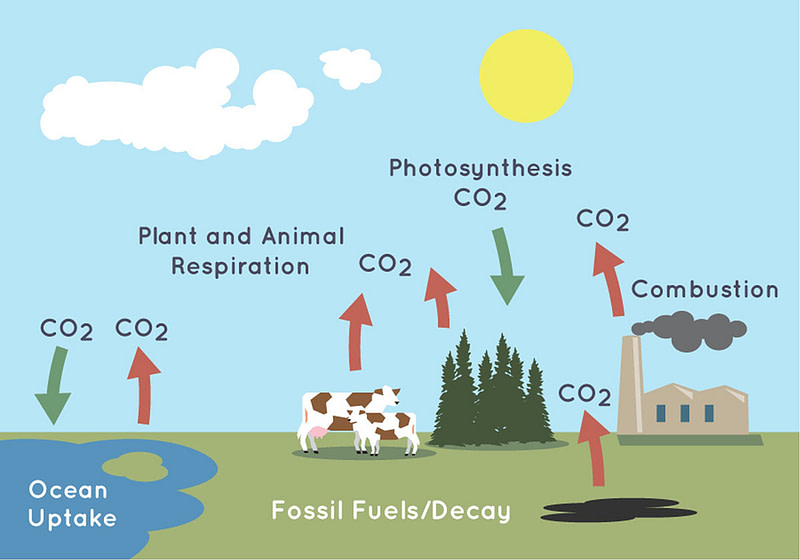
Fossil fuels are formed from the remains of dead organisms with time, heat and pressure in the earth’s crust. This means that since the industrial era started, we have released a tremendous amount of energy and carbon from ancient carbon cycles in a relatively shorter time than it took for their accumulation. These increases in atmospheric carbon levels are now causing unusually high global temperatures and abnormal weather patterns.
Spectroscopy has helped us unravel the secrets of photosynthesis
Photochemists have now developed research into solar chemicals, which store solar energy by modifying bonds in chemicals such as carbon dioxide, methane or water. They are renewable, green fuels since they depend on the sun to recycle resources from current chemical cycles (instead of prehistoric ones). Thus, they could reduce and even reverse the release of atmospheric carbon which has accelerated climate change.
Early results from flash photolysis, helped to divide photosynthesis into light-dependent and light-independent stages, which were later attributed to photosystems II and I respectively. This data was obtained with intense, short light pulses of a few microseconds (a millionth of a second), which when considered deeply, bring us to the foundation of optical spectroscopy. In this field, physical chemists “play” with light sources (at different timescales) to make as complete of a picture of a sample’s photochemical pathways as possible.
“Photochemists usually take one of two approaches in developing photocatalysts.”
Unfortunately, before the 1960s, the information gained about photosynthetic mechanisms with pulsed lamps alone was limited. Thus, the first laser introduced by Theodore H. Maiman, opened a whole new world for researchers. Shortly after this breakthrough, physical chemists could use Q-switch ruby lasers with pulses of a few nanoseconds (a billionth of a second) to clarify additional details about the reaction centres involved in photosynthesis.
As decades passed, the femtosecond scale (a quadrillionth of a second) was reached which allowed physical chemists to decipher the intermediate states involved in photosynthesis. Later with the attosecond scale (a billionth of a billionth of a second), it became possible to determine actual electron transfer reaction rates with higher accuracy. Today, these laser advances along those from X-ray crystallography have made us so acquainted with the chemistry of photosynthesis that it is now possible to design photocatalysts built on these principles.
Photochemists usually take one of two approaches in developing photocatalysts, either: (i) they synthesize bio-inspired metal porphyrins like those found in the photosystems or, (ii) they develop semiconductors which have the same intrinsic ability as photosynthetic reaction centres to absorb light and then separate photoexcited electrons (and holes) for long enough to drive chemical reactions. The latter includes quantum dots, metal oxides, metal-free organic polymer semiconductors, metal-organic frameworks etc.

Spectroscopy sheds light on mechanisms necessary for solar chemical production
I completed my PhD at Tampere University as part of the MSCA Solar2Chem project in collaboration with photochemists at Max Planck Institute of Colloids and Interfaces and Instituto de Tecnología Química. The studies used laser spectroscopy to determine the structure-function relationships of graphitic carbon-based photocatalysts to convert solar energy into solar chemicals.
The graphitic carbon-based semiconductor photocatalysts studied were doped-graphenes and graphitic carbon nitrides. They were made from readily available carbon sources with robust enough properties for future applications. The most interesting technique for me was pump-probe spectroscopy, which used one laser pulse or pump to excite samples and a second pulse or probe to monitor the response of the sample to the pump. This made it possible to study mechanisms involved in photocatalysis such as absorption, fluorescence, photoinduced energy transfer, photoinduced charge transfer etc. from the femtosecond to nanosecond scale.
“Graphene is a breakthrough material.”
Graphene is a breakthrough material which jumpstarted the field of 2D materials in the early 2000s and gave the two scientists who isolated it, the Nobel prize for Physics in 2010. It forms a repeating hexagonal pattern of carbon atoms in only one plane to form a thin but excellent “metal-like” conductor. However, when a small number of heterogeneous atoms like nitrogen, boron or phosphorous are added to this structure through doping, it becomes less conductive and starts to show capacity for photocatalysis.
Graphitic carbon nitrides have similar compositions to nitrogen doped graphene, but a larger number of nitrogen atoms turns them into semiconductors and their hexagonal network adapts to s-triazine or s-heptazine units with gaps between them. When they are made in the presence of alkali metal chlorides, leftover metal cations from the synthesis aggregate near these gaps to form poly (heptazine imides) or poly (triazine imides). In the family of graphitic carbon nitrides, the polymeric sheets aggregate and form stacks due to weak intermolecular forces called Van der Waals interactions.

Carrier trapping at nitrogen defects play a role in the activity of graphitic carbon-based photocatalysts
The first design strategy sought to understand how nitrogen doping in multi-layer nitrogen-doped graphene films made from thermal pyrolysis of biomass at different temperatures related to photocatalysis. Thermal pyrolysis of chitosan was used to produce nitrogen-doped graphene films with varying doping levels as a function of pyrolysis temperature. Spectroscopic data collected from all samples pyrolyzed at different temperatures revealed a long-lived nanosecond scale signal. Analysis of this data revealed free carrier trapping in nitrogen doped graphene, relevant for photocatalysis, which was otherwise absent in undoped graphene.
The next studies focused on the effect of various design strategies on the photocatalytic activity of carbon nitrides. Titanium dioxide formed a heterojunction with carbon nitrides which improved the charge separation lifetimes needed for photocatalysis. Adding oxamide during carbon nitride synthesis, created nitrogen-rich defects which helped to trap electrons necessary for photocatalytic reactions. These same nitrogen defects also appeared when oxamide was substituted for ammonium chloride (salmiakki). Finally, templating was found to increase the surface area and number of photocatalytic sites in carbon nitrides through mesopore formation.
These studies are among several examples in the field of physical chemistry which illustrate how optical spectroscopy allows us to closely monitor the solar-to-chemical mechanisms of photocatalysts. Information from these studies allow photochemists to rationally design cheap, efficient photocatalysts for solar chemical production. Therefore, optical spectroscopy complements the development of renewable energy technologies to support the green energy transition and mitigate climate change.

About the Author:
Jokotadeola Odutola is a physical chemist who graduated from Tampere University in 2025 with a chemistry PhD. She has her chemistry BSc. (Hons) from Babcock University and chemistry MSc. from Université Paris-Saclay and Universidade do Porto. Her doctoral thesis topic was “Charge Carrier Dynamics of Graphitic Carbon-based Photocatalysts for Solar Chemical Production.”


