Teksti Tuomas Lehtonen
In her PhD, Iris Seitz developed new strategies to template virus-mimetic structures by using DNA origami. The knowledge generated from this research advances functional biomaterials, which could find application in nanomedicine and therapeutics.
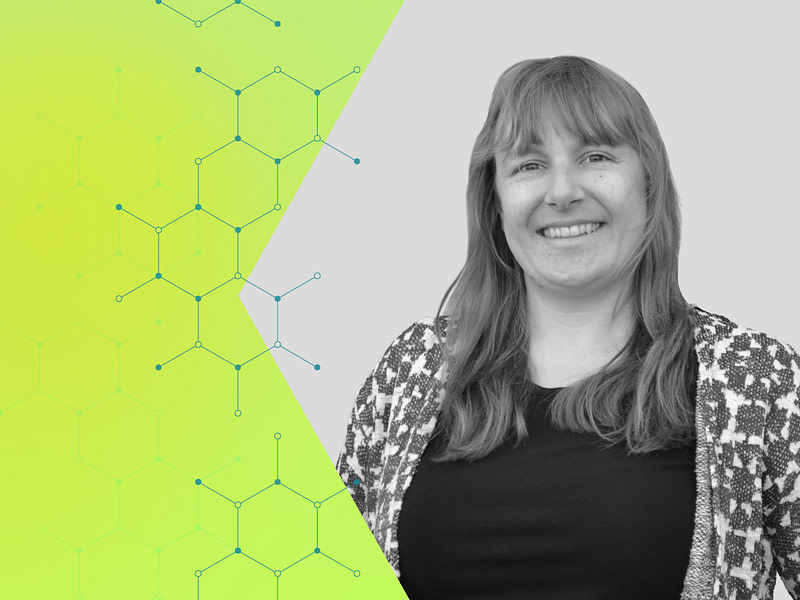
Iris Seitz, 27, explored in her PhD how DNA origami – tailored and rigid nanostructures made entirely from DNA – can be applied as a blueprint to mould proteins into a predefined shape. These proteins can be either virus capsid proteins protecting the genome of a virus or of non-viral origin.
With considered selection of the proteins or by tweaking the DNA origami, for example by incorporating RNA, a certain application-relevant function can be achieved, resulting in a highly versatile approach to build virus-mimetic structures.
As such, the findings promote the development of functional and responsive multifunctional nanomaterials with various applications including therapeutics.
What is the most significant finding of your dissertation?
”The research presented in my thesis is among the first ones to show that the assembly of virus capsid proteins can be directed by using DNA origami as a template. It allows us to gain control over the size and shape of virus-like assemblies in a modular manner, resulting in “reprogramming” of the assemblies into morphologies that differ from the ones native viruses are known for.
The assembly process is based on electrostatic interactions between the negatively charged DNA origami and the positively charged proteins and can be pictured like wrapping a present. The proteins assemble on top of custom shaped DNA origami, thereby wrapping it.
By using different proteins just like different wrapping paper certain properties can be assigned to the protein-DNA origami assemblies, resulting in, among others, protection, targeting, and enhanced uptake into cells.
More importantly, we were able to tweak the assemblies to perform application-relevant functions by exploiting the key characteristics of DNA origami structures, programmability and addressability. It for instance enables us to precisely place enzymes along the surface of the DNA origami, advancing them into biocatalytic nanoreactors.”
”We found a way to successfully upgrade the DNA origami with messenger RNA.”
Most strikingly, we found a way to successfully upgrade the DNA origami with messenger RNA (mRNA) allowing the mRNA-DNA origami to be transformed into a protein in cells in a controllable manner. We know therapeutic mRNA for example from its use in COVID-19 vaccines.
My doctoral thesis highlights the applicability of using origami to template virus mimicking assemblies and advances the development of rationally designed functional and responsive protein-origami-based multipurpose systems.”
How can your findings be applied?
“We live in a world where we get inspired by highly complex systems found in nature, such as cellular processes. In our aims of not only understanding and copying, but ultimately outperforming these amazing systems, the development of hybrid nanomaterials is of essence.
My systems are based on DNA (origami) and proteins, two building blocks that both have distinct but unique properties – the programmability and addressability of DNA origami on the one hand, and the functionality and chemical heterogeneity of proteins on the other.
Merging these two materials allows us to exploit their beneficial properties in novel, functional biomaterials. Additionally, my systems are highly versatile due to their modularity.
Therefore, my thesis provides an excellent springboard to further advance the developed systems, but even more so, to encourage thriving towards more intriguing ones. The ability to precisely place enzymes into a DNA origami template while simultaneously gating enzyme-substrate interactions through a protein layer is reminiscent of compartmentalization. One could think of it as offering a sophisticated approach, for instance, for enzyme replacement therapy.
Similarly, using protein-encoding RNA or DNA scaffolds in the origami template has the potential of advancing nucleic acid therapeutics. It is one approach to control the morphology of a nanocarrier and might come in handy in modulating its cellular uptake.
”I believe in the potential of developing novel, more intriguing ones.”
”While my work highlights the versatility of my platforms, I believe in the potential of developing novel, more intriguing ones. Such novel systems might additionally benefit from a combination of several (wrapping) components exhibiting a synergistic effect. Their development, in return, is supported by the large toolbox available for manipulating or de novo designing proteins.”
What did completing your dissertation mean to you?
”I have always been curious to learn new things and enjoyed myself spending countless hours in labs working on several interesting topics during summer internships and my undergraduate studies. However, it always felt like a sneak peak only.
During my PhD, I got the chance to really dive deeply into one specific project. It’s rather satisfying to grasp the “ins and outs” of one’s project, while being at the same time amazed, puzzled, and challenged by exactly those and driven to dig even deeper.
But I will remember my PhD journey as so much more than just science, it gave me the chance to grow on a personal level. I was fortunate enough to conduct my research in a group, in which we help and support each other.
Therefore, the journey was an opportunity to test my own limits, the ability to overcome seemingly impossible challenges, and the freedom and encouragement to develop my own ideas. It was planning and supervision skills, scientific writing but also making the research available for a public audience. And it’s the friendships you make – spanning the globe.
So, I’m completing my PhD with a tear in one eye and a smile in the other. The tear because there would be so many more questions to rack one’s brain, and the smile because of gratitude, delight, and all the opportunities to come to continue learning.”
What are your next career steps?
”I will continue as a postdoctoral researcher at Aalto University in Professor Mauri Kostiainen’s research group (Biohybrid Materials) until the end of the year. My plans after are currently still open, but I am looking forward to continuing doing research and expanding my toolbox.”
What works best as a counterbalance to your work – how do you clear your mind from research?
I really enjoy spending time outside exploring nature, since the silence there helps me relax and order my thoughts. This can for example be sitting by the shore and listening to the sea while reading a fiction book as counterbalance to the scientific texts.
Quite often, it’s combined with some kind of sports. During summer, one can find me biking along the shore, hiking in the woods or sailing, whereas in winter, I’ll probably wear ice skates or skies.”
MSc Iris Seitzin kemian tekniikan alaan kuuluva väitöskirja Virus-mimetic structures through protein engineering and nucleic acid origami tarkastettiin 18.6.2025 Aalto-yliopistossa. Vastaväittäjänä toimi professori professori Nicholas Stephanopoulos, Arizona State Universitysta Yhdysvalloista ja kustoksena professori Mauri Kostiainen, Aalto-yliopiston kemian tekniikan korkeakoulusta.
Lue lisää:
Reprogramming the shape of virus capsids could advance biomedicine
Light responsive DNA origami detects breast cancer marker
Sofia Julin: DNA-origamirakenteet ovat myös hyviä nanomateriaalien rakennuspalikoita