Harnessing Strong Light-Matter Coupling for Next-Generation Organic Solar Cells
Text and photo Sokolovskii Ilia
Strong coupling of organic molecules with confined electromagnetic fields in optical cavities holds a great promise for improving the efficiency of organic optoelectronic devices. In particular, the light-matter hybridization enhances excitation energy transport, which is of high importance for the efficient operation of organic solar cells. Recent computational studies by researchers from the University of Jyväskylä shed light on this phenomenon, providing insights crucial for the rational design of novel, cavity-improved solar cells.
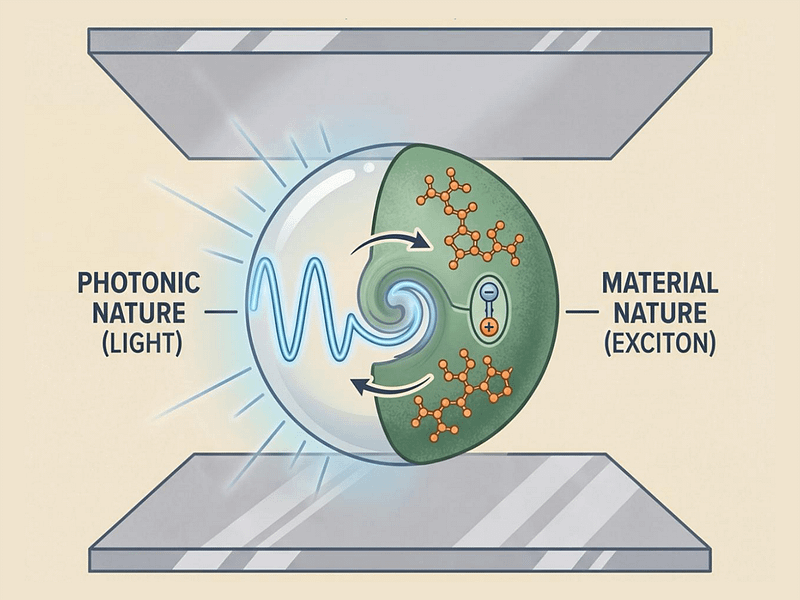
Schematic illustration of a polariton in a microcavity as a hybrid entity, combining photonic (light) properties and material (exciton) properties. AI-generated image.
Organic electronics and optoelectronics offer a number of unique advantages over traditional inorganic technologies. These include mechanical flexibility and lightness, ease and low manufacturing cost, chemical tunability, and biocompatibility. Whereas organic technology has been already widely adopted in the global marker of light-emitting diodes (LEDs), including LED displays, the commercialisation of other organic-based devices, such as lasers and solar cells, is currently impossible due to various obstacles, including low efficiency and often short device lifetime.
Recently, it has been proposed to exploit the strong coupling of molecules with confined electromagnetic fields in optical resonators, or cavities, to improve the efficiency of organic optoelectonic devices. This, along with other potential applications of strong coupling, has led to the emergence of the fascinating new field of molecular polaritonics.
Two-faced Janus of microcavities
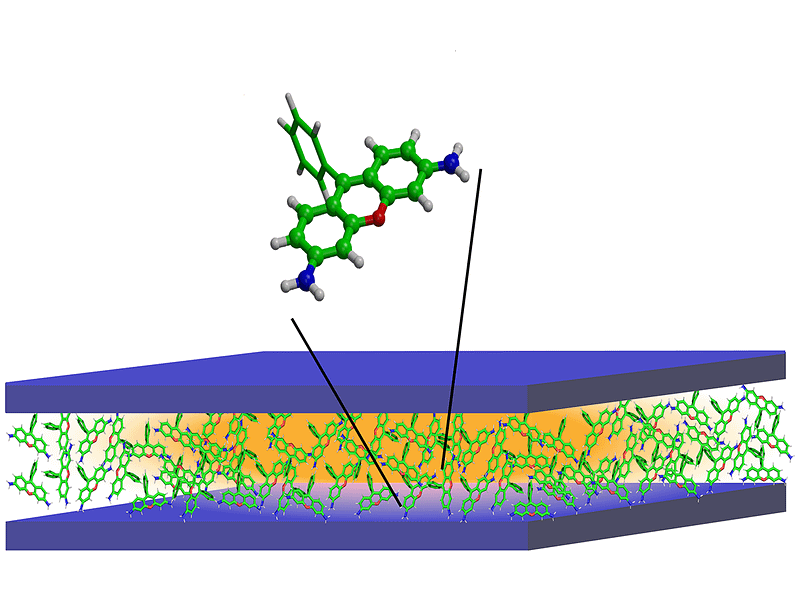
Unlike free space, in which electromagnetic field is normally uniform, inside an optical microcavity, built by placing two parallel metallic plates in the simplest configuration, the field is squeezed into a small volume and significantly amplified.
This creates conditions for very strong interactions between the field and the molecules trapped within the cavity. If the frequency of the field is at resonance with the frequency of molecular absorption, the two ingredients hybridise into composite light-matter states, conventionally termed exciton-polaritons, which combine both photonic and material properties. This unique hybrid nature of polaritons opens the way to a variety of potential applications, from biosensors and computing logics to low-threshold lasers and chemical reactions control.
Schematic illustration of organic molecules inside an optical microcavity, made of two parallel metallic mirrors. The molecules are strongly coupled to the electromagnetic field in the cavity (orange area), resulting in the formation of polaritons.
Some properties of polaritons have already been utilised to demonstrate the improvement of organic LEDs and photodiodes, while others are still waiting for their time. For instance, the ability of polaritons to form a collective quantum state, the so-called Bose-Einstein condensate, at room temperature, unlike cryogenic condensates of atoms, is promising for the development of low-threshold lasers that consume significantly less electric power compared to conventional lasers.
Another captivating example of molecular polaritonics is cavity-modified chemistry, demonstrated in a series of recent experiments. However, despite initial excitement, the exact mechanism and the generalisability of the phenomenon to a wide range of chemical reactions remain open questions, requiring more thorough experimental and theoretical investigation.
The field has now reached a turning point, and the next few years will reveal whether the unique properties of polaritons can be exploited in real-world applications.
Overall, the field of molecular polaritonics has gained considerable interest in recent years across various branches of physics and (bio)chemistry. The field has now reached a turning point, and the next few years will reveal whether the unique properties of polaritons can be exploited in real-world applications.
Potential to improve solar cells
One of the most appealing consequences of strong coupling is the enhancement of excitation energy transport within the coupled material, outpacing the diffusion of charge carriers in the same material outside the cavity. This effect might potentially find use for improving organic optoelectronic devices, especially solar cells.
Roughly, the operation of a solar can be divided into four stages: i) absorption of sunlight and subsequent formation of bound electron-hole pairs, or excitons; ii) exciton drift towards charge-separating interfaces; iii) charge separation at the interface; and iv) transport of free charges to the electrodes. Thus, the overall difference in efficiency between a conventional and a polaritonic solar cell can be appreciated by comparing the efficiencies of the four stages in these devices, as outlined below.
Although the use of a metal mirror instead of semitransparent upper electrode may deteriorate absorption in a polaritonic solar cell compared to a conventional device, replacing the two-mirror cavities with so-called open-cavity structures or structures supporting self-hybridised polaritons may neutralise this problem, resulting in comparable efficiencies of light absorption in the devices.
Exciton transport was shown to be enhanced in the cavity in a variety of experimental and theoretical works. Among several international groups, the group of Prof. Gerrit Groenhof at the University of Jyväskylä has made a significant contribution to the understanding of this phenomenon. In a series of works recently published in peer reviewed journals, the group developed a simulation model of exciton-polariton transport in organic semiconductors and performed atomistic molecular dynamics simulations on high performance computing facilities provided by the Finnish national supercomputing center CSC. Based on the simulation results, the authors proposed a general mechanism of cavity-enhanced excitation energy transport in terms of high speed of polaritons due to their half-photonic nature and interaction of polaritons with molecular vibrations due to polaritons’ half-material nature. These insights are crucial for designing cavity-molecule structures that are most advantageous for efficient excitation energy transfer.
Regarding charge separation and subsequent transport of free charges, the influence of strong coupling on these steps is not fully understood, although the existing experiments and theoretical studies suggest that the efficiency of these steps is at least as good, and perhaps even better, than in uncoupled molecules. A mechanistic understanding of these effects is one of the current research interests of the author of this article, which he is now pursuing at the University College London.
Summarising, strong light-matter coupling has great potential for improving organic solar cells, as suggested by experiments and computational studies, but further research is needed before we can see polariton solar cells on the roofs of our houses and cars.
Sokolovskii Ilia
Education: Completed PhD in chemistry at the University of Jyväskylä (Nanoscience Center; Department of Chemistry). Current place of work: University College London (Physics and Astronomy Department). Area of expertise: computational chemistry, molecular dynamics, material physics.