Teksti Asiia Hurskainen, kuvat Iryna Makarava
Additive manufacturing, or 3D printing, is finding its way into separation science. Finnish researchers are exploring how 3D printing can be used to design porous and functional materials for metal recovery and water purification. This approach offers sustainable and customizable solutions for future separation technologies.
Separation processes are essential in chemical engineering, especially today, when industries move toward more sustainable and circular material use. Whether it is the separation of heavy metals from wastewater or the recovery of valuable elements from secondary resources, the performance of these processes depends strongly on the properties of the separation material.
Traditional adsorbents and ion-exchange resins have served this purpose for decades, but their structures are often limited by the way they are produced, as packed beads or powders that restrict flow and diffusion. This is where additive manufacturing offers something new.
From traditional columns to 3D printed structures
Additive manufacturing allows a new level of control for chemical separation processes. The efficiency of adsorption and ion exchange columns depends on several factors such as flow distribution, surface area, mass transfer and the performance of the material itself.
3D printing allows the precise design of the packed-bed geometry, enabling higher reproducibility and improved performance compared with a randomly packed column.
By eliminating channelling and dead zone, printed structures ensure more uniform contact between the liquid and the sorbent. Printed geometries also allow control over pressure drop, enabling higher flow rates without reducing efficiency.
Several 3D printing techniques also give us the possibility to use different materials within one print. This gives opportunity for creating multi-material systems, which can increase the selectivity and efficiency of the separation process.
3D Printed separation technologies in Finland
There are several research groups in Finland that focus on 3D printing for separation processes. At the University of Jyväskylä researchers were among the first in Finland to develop 3D printed porous structures with integrated functional materials capable of selective recovery of metals from complex solutions.
This innovation has already reached the commercial stage through Weeefiner, a spin-off company using their 4D Scavenger technology for industrial water purification and metal recovery.
At LUT University, the research group of Professor Eveliina Repo have been exploring similar concepts using a selective laser sintering (SLS) 3D printer to fabricate nylon-based sorption modules for various applications such as the recovery of indium, arsenic or copper ions from waste streams or tailings.
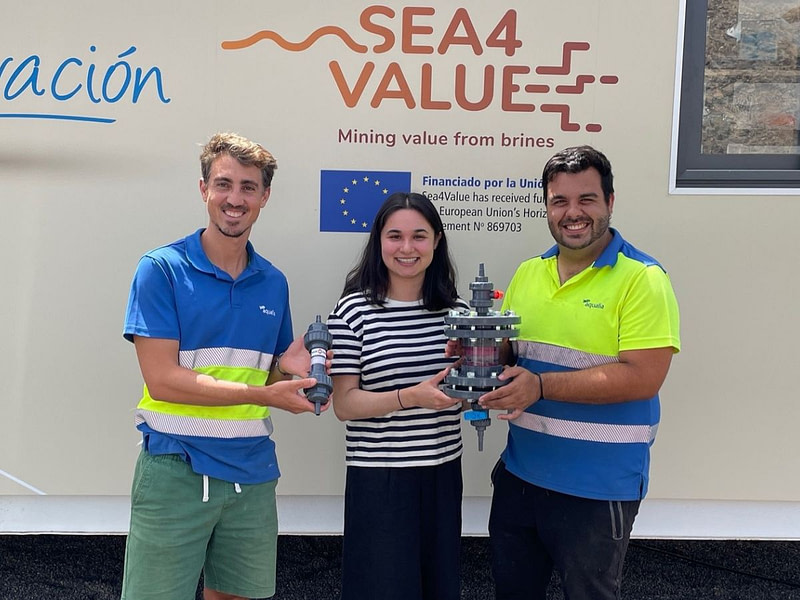
Promising results were obtained during the EU-funded project Sea4Value, which aimed to recover valuable elements from seawater brine. Nylon-based sorption modules incorporating ion-exchange resins were manufactured and tested with synthetic seawater brine at LUT University.
In collaboration with Weeefiner, we developed larger 3D-printed modules (4D Scavengers) for the selective recovery of boron, molybdenum and vanadium ions from seawater brine.
These columns were tested in a Moving lab located in Tenerife, using brine from the local desalination plant in Adeje. Over 70 % of molybdenum and vanadium ions and around 90 % of boron ions, were selectively recovered from the highly complex multi-ion stream.
”The design freedom of 3D printing is limited by printing resolution.”
Challenges inspire creativity
Although the technology shows great potential, it is not without challenges. In practice, the design freedom of 3D printing is limited by printing resolution.
For example, powder bed fusion techniques such as SLS cannot produce microchannels, and the resulting structures contain mostly random pores formed by unsintered powder during printing.
Additively manufacturing techniques such as stereolithography (SLA), material jetting or extrusion-based direct ink writing (DIW) use curable photopolymer resins as printing material and therefore offer the highest printing resolution, enabling the design of micropores and microchannels. However, commercially available printing resins are not suitable for adsorption or ion-exchange applications.
These challenges also highlight why 3D printing remains an interesting approach for researchers. There is plenty of room for creativity and problem-solving mindset. In addition, it allows us to explore new materials, shapes and process concepts in a much faster cycle than conventional manufacturing.
”It may become possible to print structures that combine the desired geometry and the correct chemical composition in a single step.”
Next steps: Direct 3D printing of ion-exchange resin
In contrast to printing sorption modules from powder beds, we could explore additive manufacturing techniques that use polymer resins as printing materials.
These AM techniques offer much higher printing resolution and can produce well-defined microchannels within the structure, that could improve flow uniformity and enhance overall mass-transfer efficiency in separation column.
By formulating printable inks or pastes containing the necessary monomers with specific functional groups (such as sulfonic or amine groups) and crosslinkers it would open entirely new design possibilities.
Curing the material layer by layer with UV light, it may become possible to print structures that combine the desired geometry and the correct chemical composition in a single step. Something that conventional resin synthesis cannot achieve. The main challenge is ensuring sufficient mechanical and chemical stability of the printed material.
This direction offers new possibilities in both material formulation and structural design. However, much more research is needed before these ideas can be translated into practical applications.
Strengthening Finland’s 3D printing Ecosystem
Finland’s growing expertise in additive manufacturing gives a strong foundation for future innovations. Close collaboration between universities and industry could enable 3D printing to improve the efficiency and sustainability of separation and purification technologies.
Read also:
From Finnish Graphite to Sustainable Graphene for Renewable Energy
Väitös toi uusia keinoja sisävesien elohopeaongelman ratkaisemiseksi